A Life Cycle-Based Integrated Assessment of Environmental Burdens and Economic Benefits of Soybean Cultivation across Multiple Provinces
DOI:
https://doi.org/10.70737/by72sw07Keywords:
soybean cultivation; life cycle assessment; life cycle cost analysis; environmental external cost; environmental risk contributionAbstract
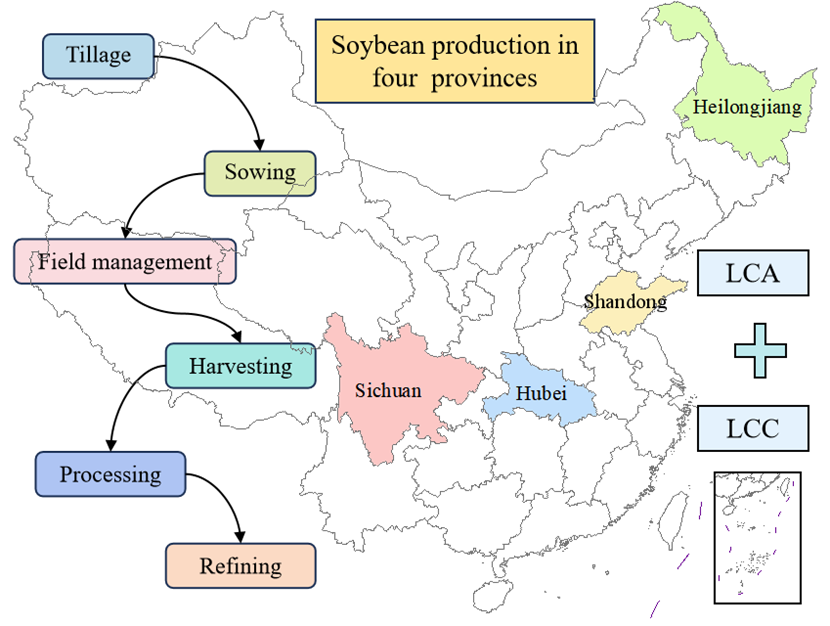
To reveal regional differences in the environmental and economic performance of soybean cultivation, this study evaluated production systems in Heilongjiang, Hubei, Shandong, and Sichuan using life cycle assessment and life cycle cost analysis. A system boundary covering cultivation and processing stages was established to quantify environmental impacts, environmental external costs, and economic returns. The results revealed significant regional differences. Shandong exhibited the highest normalized environmental impact, followed by Hubei, Heilongjiang, and Sichuan. By-product processing, refining, and main-product processing were the major contributors to environmental impacts, with by-product processing accounting for approximately 50% of the total impact. Environmental risk contribution analysis showed that air- and soil-related impacts dominated the environmental external cost structure, together accounting for more than 94% of the total environmental external cost across all four provinces. From the producer perspective, Hubei and Shandong achieved the highest net incomes, whereas Heilongjiang experienced a net loss. After environmental external costs were incorporated, the environment-adjusted net incomes of all four provinces became negative, indicating that current market returns were insufficient to offset life cycle environmental damage costs. These findings suggest that improving the environmental-economic sustainability of soybean cultivation should prioritize cleaner processing, optimized agricultural input management, higher production efficiency, and region-specific policy measures to reduce environmental externalities.
References