Electricity-Carbon Integration for Zero-Carbon Industrial Parks: A Systematic Framework from Power System Transformation to Carbon Management
DOI:
https://doi.org/10.70737/wkrt1307Keywords:
zero-carbon industrial park; electricity-carbon integration; virtual power plant (VPP); dynamic carbon emission factor; carbon management; power market reformAbstract
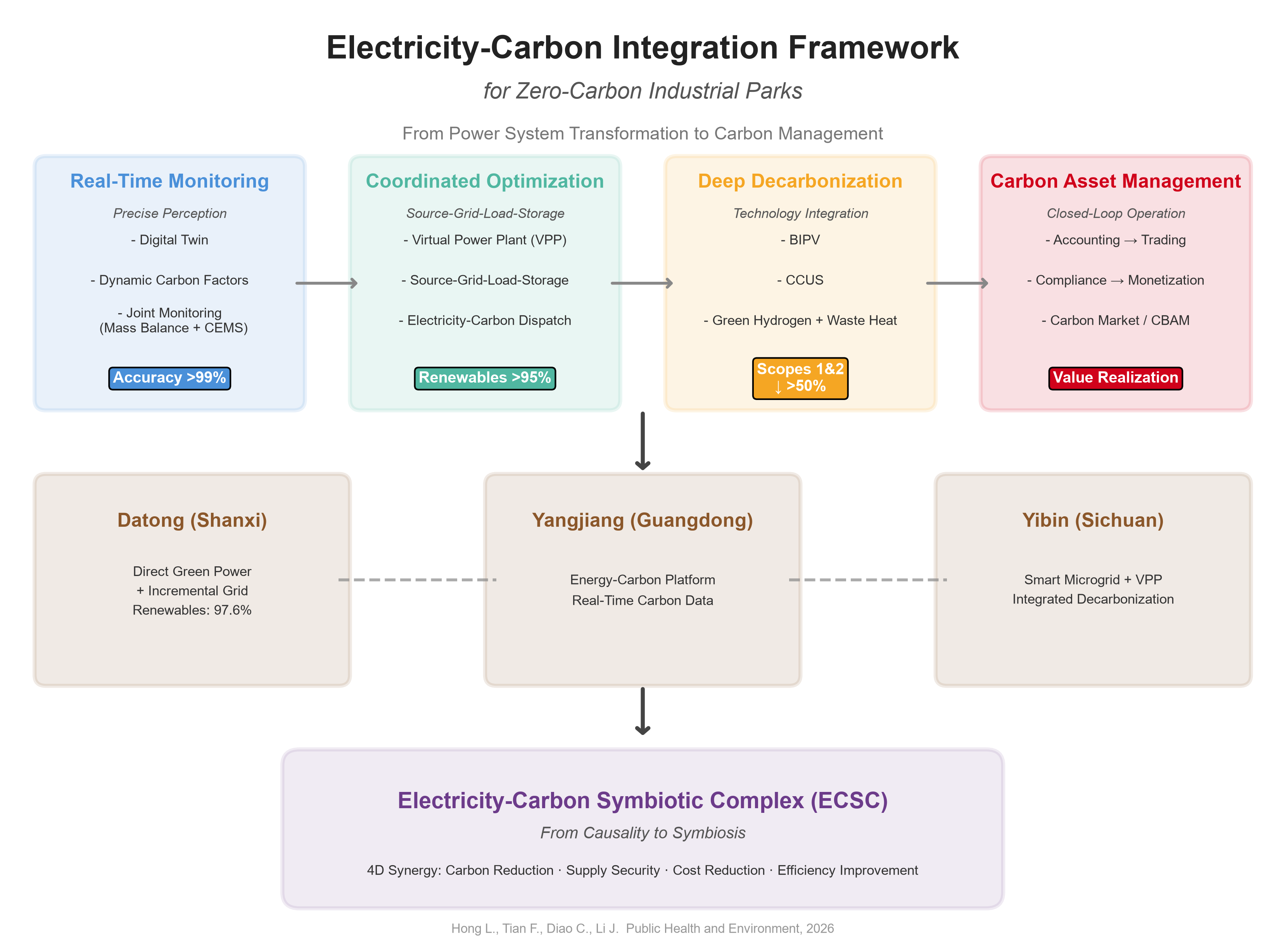
Industrial parks are critical hubs of global energy consumption and carbon emissions, contributing approximately one-third of global CO₂ from industrial agglomerations and 31% of China’s total emissions. As the ultimate form of low-carbon transition for these clusters, zero-carbon industrial parks have become a central focus for policymakers and researchers worldwide. This paper presents a systematic framework for zero-carbon industrial parks centered on the concept of electricity-carbon integration–the deep coupling of power systems and carbon management systems. The framework encompasses four technical pillars: (1) real-time monitoring of energy and carbon flows using digital twin technology and dynamic emission factors; (2) coordinated optimization through source-grid-load-storage interaction and electricity-carbon joint dispatch, with virtual power plants (VPPs) as a key enabler; (3) deep decarbonization through mature technologies (e.g., BIPV(Building-Integrated Photovoltaics), waste heat recovery) and negative-emission technologies (e.g., CCUS(Carbon Capture, Utilization and Storage), green hydrogen); and (4) closed-loop carbon asset management covering accounting, trading, and compliance. The paper systematically analyzes China’s power market reforms, develops VPP(Virtual Power Plant) aggregation and multi-timescale dispatch models, and establishes a comprehensive carbon monitoring system incorporating top-down atmospheric inversion and bottom-up joint monitoring (mass balance + CEMS(Continuous Emission Monitoring Systems)) with a relative deviation reduced from 19.45% to 0.02%. Hourly dynamic carbon emission factors and product carbon footprint accounting methods aligned with international “3-pillar” principles are also developed. Three national-level pilot zero-carbon parks in Datong, Yangjiang, and Yibin demonstrate the feasibility of the proposed framework, achieving renewable energy penetration rates exceeding 95% and carbon emission intensity reductions of over 50% for Scopes 1 and 2(the core optimization targets of the electricity-carbon dispatch model), while a supplementary Scope 3 accounting module provides full-chain carbon inventory for certification purposes. Based on these findings, the paper proposes the theoretical concept of the Electricity-Carbon Symbiotic Complex (ECSC), which reconceptualizes the relationship between power systems and carbon management from causality to symbiosis, enabling four-dimensional synergies: emission reduction, supply security, cost reduction, and efficiency improvement. Policy recommendations include establishing national technical guidelines for electricity-carbon integration, accelerating the convergence of VPPs with carbon management platforms, and piloting hourly dynamic carbon factors in carbon trading and green power certification.
References