Life Cycle Assessment of Carbon Cycling and Environmental Impacts in Mussel Farming
DOI:
https://doi.org/10.70737/br8pek49Keywords:
mussel aquaculture; life cycle assessment; carbon cyclingAbstract
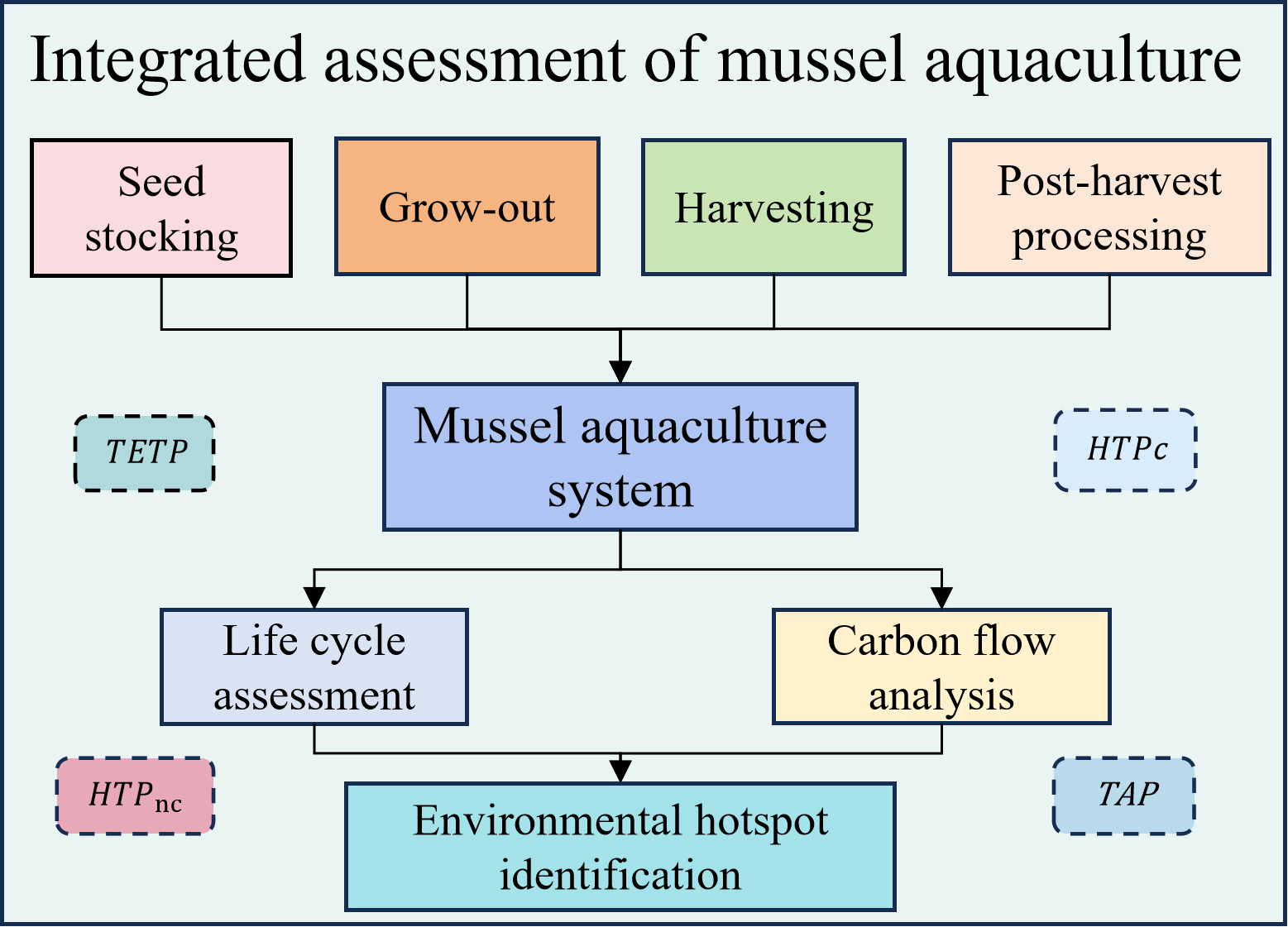
Under China’s dual carbon targets and the green transition of aquaculture, understanding carbon flows and life cycle environmental impacts is important for evaluating the ecological performance of mussel farming. This study assessed typical mussel aquaculture areas in Zhejiang Province using life cycle assessment combined with carbon flow analysis, covering seed stocking, grow out and harvesting stages. The carbon flow analysis used 1.45 kg C as the normalized total carbon use basis. Of this amount, 0.21025 kg C was allocated to carbon removal, 0.97585 kg C to storage related pathways, 0.09860 kg C to respiration related release, and 0.16530 kg C to calcification related release. Carbon removal and storage related pathways together accounted for 81.8% of the normalized carbon use basis, indicating that the model allocated a larger proportion of carbon to potential removal and local retention pathways than to release pathways. This allocation pattern is consistent with a potential weak and seasonally constrained carbon sink function under favorable environmental conditions, although it does not independently demonstrate net atmospheric CO₂ removal. The main environmental impact categories were terrestrial ecotoxicity potential (TETP), which contributed 35.03%, human non-carcinogenic toxicity potential (HTPnc), which contributed 22.79%, human carcinogenic toxicity potential (HTPc), which contributed 18.30%, terrestrial acidification potential (TAP), which contributed 8.51%, fossil resource scarcity potential (FFP), which contributed 5.65%, and freshwater ecotoxicity potential (FETP), which contributed 4.89%. For monetized environmental impacts, HTPnc made the largest contribution, followed by FFP, TAP, global warming potential (GWP) and fine particulate matter formation potential (PMFP). Overall, mussel aquaculture may contribute to local carbon cycle regulation and may provide a weak, seasonal and context dependent carbon sink function; however, the present results do not independently demonstrate that the farming system functions as a net atmospheric CO₂ sink.
References