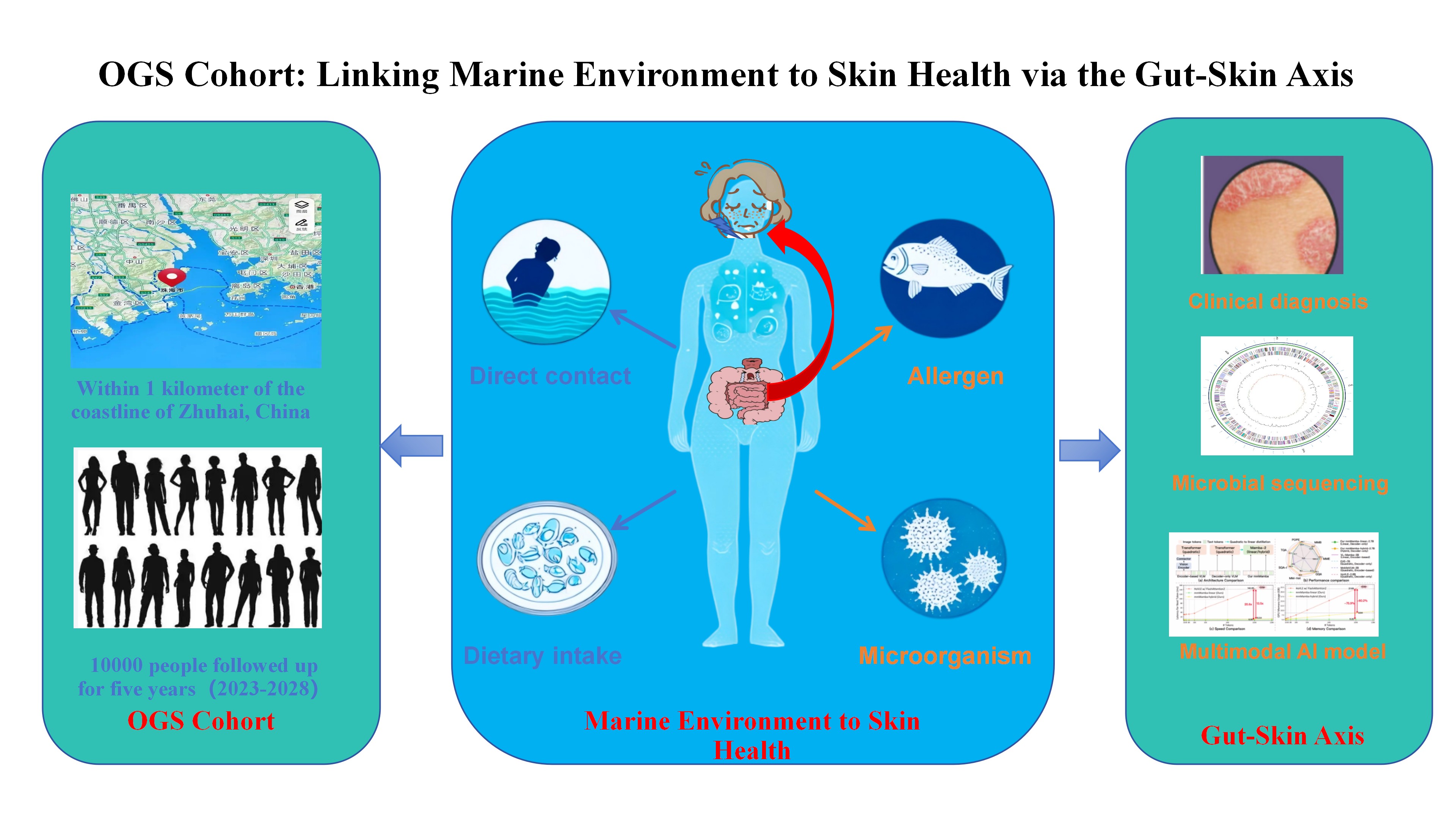
The Ocean–Gut–Skin (OGS) Cohort: Baseline Characteristics and Study Protocol for a Prospective Investigation of Marine Environmental Exposure and Dermatological Health in Coastal China
DOI:
https://doi.org/10.70737/r9j45797Keywords:
Psoriasis; Atopic dermatitis; Cohort study; Gut microbiome; Skin microbiome; Marine environment; Environmental exposure; Study protocolAbstract
Psoriasis is a chronic, immune-mediated inflammatory skin disease with a complex etiology involving both genetic susceptibility and environmental triggers. Accumulating evidence points to a critical role for the gut microbiome in modulating systemic immunity and cutaneous homeostasis—a relationship encapsulated by the "gut–skin axis". However, the potential influence of environmental microbial exposures, particularly those originating from distinctive marine ecosystems, on this axis remains unexplored. We hypothesized that occupational or residential exposure to the marine environment shapes the human microbiome (both cutaneous and intestinal), which in turn modulates the risk and severity of psoriasis. This article presents the study protocol and baseline characteristics of the Ocean–Gut–Skin (OGS) Cohort Study, the first prospective cohort in China dedicated to investigating marine-associated dermatological disorders. The OGS Cohort Study was initiated in January 2023 in Zhuhai, a major coastal city in southern China. The target population comprises 10,000 adults aged 30–70 years, stratified into high and low marine exposure groups. Participants undergo comprehensive health examinations, including dermatological assessment (Psoriasis Area and Severity Index [PASI], Eczema Area and Severity Index [EASI], Dermatology Life Quality Index [DLQI], and transepidermal water loss [TEWL]), collection of stool and skin swab samples for 16S rRNA gene sequencing and shotgun metagenomics, blood sampling for biomarker profiling, and a detailed questionnaire capturing demographic, lifestyle, dietary, medical history, and marine exposure metrics. Participants will be followed biennially for the first 2 years and annually thereafter for a total of 5 years. Baseline recruitment was completed in December 2025, yielding a cohort of 10,245 participants across five study phases. This paper reports the baseline demographic and clinical characteristics of the cohort. The mean disease duration was 8.5 years for psoriasis and 6.2 years for atopic dermatitis (AD). The cohort comprises 2512 psoriasis patients, 2488 AD patients, and 2500 healthy controls, with comprehensive multi-omics data collected at baseline. Follow-up is ongoing. The OGS Cohort Study is uniquely positioned to interrogate the novel "Ocean–Gut–Skin" axis. By integrating deep clinical phenotyping with multi-omics microbiome analyses and rigorous environmental exposure assessment, this cohort will generate robust evidence on how the marine environment may indirectly influence cutaneous health through modulation of the human microbiome.
References