Authors
-
Lieyang Fan
Institute for Chemical Carcinogenesis, School of Public Health, Guangzhou Medical University, Guangzhou 511436, China
Author
-
Shaojuan Wang
Institute for Chemical Carcinogenesis, School of Public Health, Guangzhou Medical University, Guangzhou 511436, China
Author
-
Changli Tu
Department of Pulmonary and Critical Care Medicine, Fifth Affiliated Hospital of Sun Yat-sen University, Zhuhai 519000, China
Author
-
Chenghui Zhong
Institute for Chemical Carcinogenesis, School of Public Health, Guangzhou Medical University, Guangzhou 511436, China
Author
-
Meiqi Lan
Institute for Chemical Carcinogenesis, School of Public Health, Guangzhou Medical University, Guangzhou 511436, China
Author
-
Shuguang Wang
Institute for Chemical Carcinogenesis, School of Public Health, Guangzhou Medical University, Guangzhou 511436, China
Author
-
Lan Qiu
Institute for Chemical Carcinogenesis, School of Public Health, Guangzhou Medical University, Guangzhou 511436, China
Author
-
Wenfeng Lu
Institute for Chemical Carcinogenesis, School of Public Health, Guangzhou Medical University, Guangzhou 511436, China
Author
-
Xiaole Xu
Institute for Chemical Carcinogenesis, School of Public Health, Guangzhou Medical University, Guangzhou 511436, China
Author
-
Liqiu Qiu
Institute for Chemical Carcinogenesis, School of Public Health, Guangzhou Medical University, Guangzhou 511436, China
Author
-
Mengnan He
Institute for Chemical Carcinogenesis, School of Public Health, Guangzhou Medical University, Guangzhou 511436, China
Author
-
Jiajing Wang
Institute for Chemical Carcinogenesis, School of Public Health, Guangzhou Medical University, Guangzhou 511436, China
Author
-
Jingwen Fang
Institute for Chemical Carcinogenesis, School of Public Health, Guangzhou Medical University, Guangzhou 511436, China
Author
-
Zhizun Deng
Institute for Chemical Carcinogenesis, School of Public Health, Guangzhou Medical University, Guangzhou 511436, China
Author
-
Yingxin Chen
Institute for Chemical Carcinogenesis, School of Public Health, Guangzhou Medical University, Guangzhou 511436, China
Author
-
Hongjie Shen
Southern Marine Science and Engineering Guangdong Laboratory (Zhuhai), Zhuhai 519000, China
Author
-
Xiaoliang Li
Zhuhai Center for Chronic Disease Control and Prevention, Zhuhai 519060, China
Author
-
Jing Liu
Department of Pulmonary and Critical Care Medicine, Fifth Affiliated Hospital of Sun Yat-sen University, Zhuhai 519000, China
Author
-
Yun Zhou
Institute for Chemical Carcinogenesis, School of Public Health, Guangzhou Medical University, Guangzhou 511436, China
Author
Keywords:
microplastics; cohort study; bronchoalveolar lavage fluid; respiratory disease; shape parameter; LDIR
Abstract
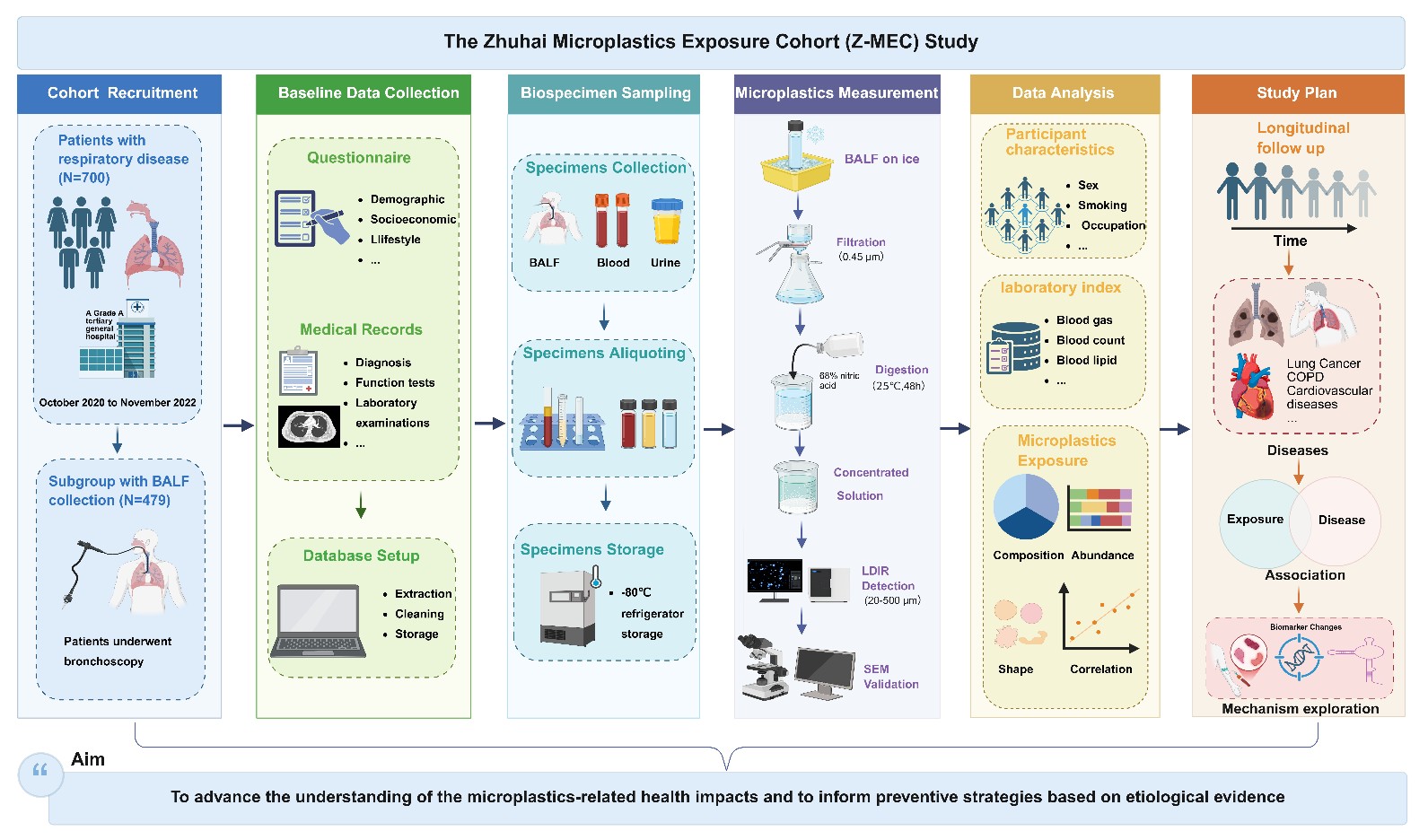
Increasing evidences have indicated a human internal exposure of Microplastics (MPs), whereas epidemiological evidence linking MPs to health outcomes remains limited, especially from prospective cohort studies. We established the Zhuhai Microplastics Exposure Cohort (Z-MEC), a hospital-based prospective cohort of 700 patients with respiratory diseases between October 2020 and November 2022. Apart from blood and urine sampling, bronchoalveolar lavage fluid (BALF) of patients undergoing bronchoscopy was further collected to evaluate MPs burden using both the laser direct infrared (LDIR) and scanning electron microscopy. Clinical data, laboratory indices, and questionnaire information were also obtained at baseline, and repeatedly collected during the scheduled follow-up according to the individual medical care. Among 479 participants with BALF, the detection rate of total MPs reached 96.12%, with a median abundance of 115.02 (IQR, 34.77–303.43) particles per gram of BALF. The most prevalent polymers included polyethylene (PE), high-density polyethylene (HDPE), polyurethane (PU), and polyvinyl chloride (PVC). Detailed morphological analysis revealed that inhaled MPs are typically irregular in shape, and larger-sized particles have been found deep within the lungs. In summary, the ongoing Z-MEC study serves as a vital platform for research on MPs exposure assessment and their potential health impacts.