Valorization of Heterogeneous Waste Cooking Oils for Efficient Microalgae Harvesting
DOI:
https://doi.org/10.70737/pdm1yt90Keywords:
microalgae harvesting; waste cooking oil heterogeneity; buoy-bead flotationAbstract
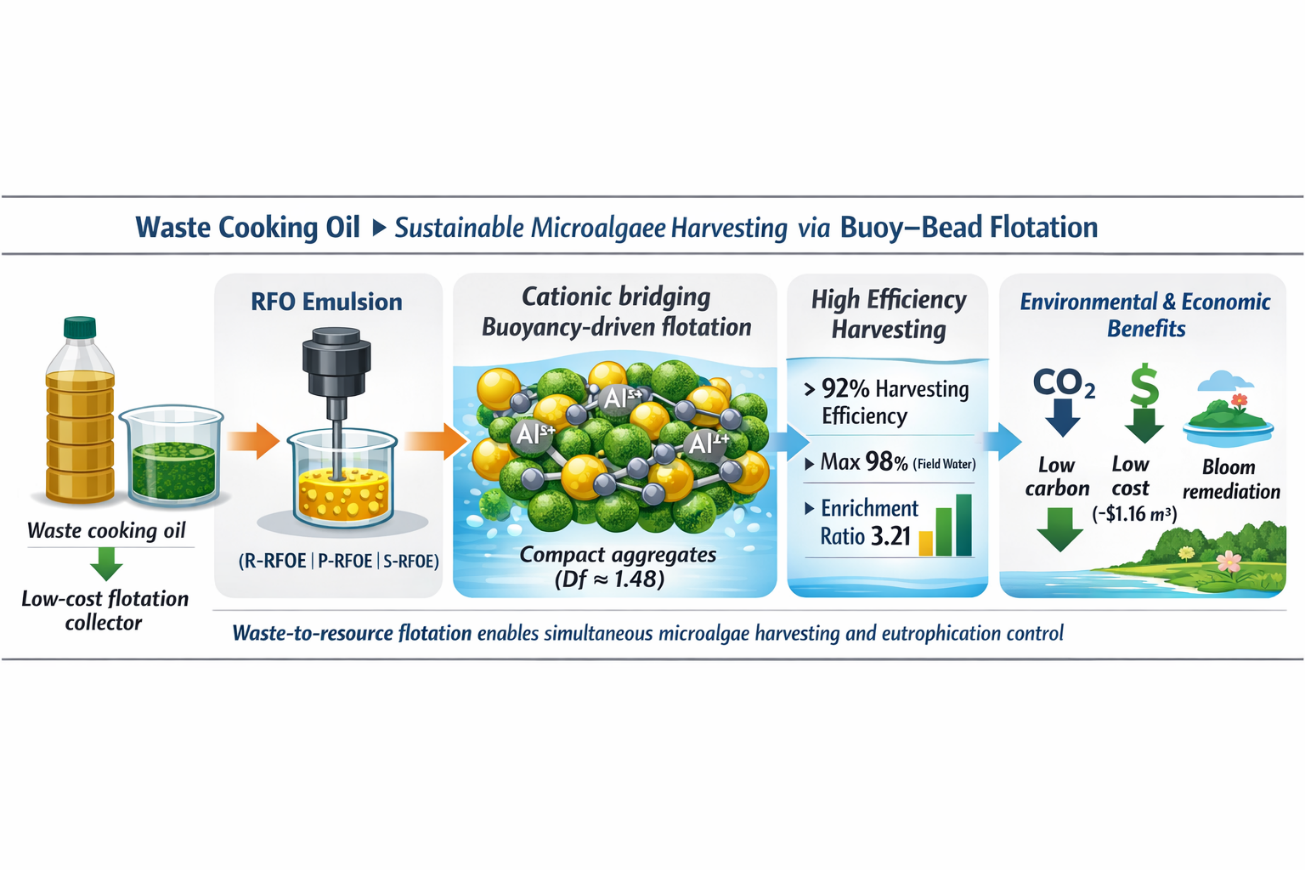
To achieve the high-value valorization of waste cooking oil (WCO) and address the economic bottleneck of microalgae harvesting, this study proposes a sustainable buoy-bead flotation strategy. Emulsions derived from three typical WCO sources (Rapeseed, Peanut, and Soybean) were evaluated to optimize this “waste-to-resource” process. Results demonstrated that Peanut Re-Frying Oil Emulsion (P-RFOE) and Soybean Re-Frying Oil Emulsion (S-RFOE) exhibited superior harvesting performance, achieving efficiencies exceeding 92% under optimized conditions. Mechanistic analysis revealed that these substrates formed highly compact aggregates (Df = 1.48) via aluminum sulfate-mediated cationic bridging, marginally enhancing resistance to hydrodynamic shear. The method’s ecological adaptability was validated through the in-situ remediation of natural blooms in three eutrophic lakes, achieving a peak harvesting efficiency of 98.03% (Chaohu Lake) and a high enrichment ratio of 3.21 (Luoma Lake). Furthermore, a gate-to-gate Life Cycle Assessment (LCA) confirmed the system’s sustainability, featuring a competitive operational cost (1.16/m³), a minimal carbon footprint (0.066 kg CO₂-eq/m³), and no secondary pollution. This study establishes a cost-effective, eco-friendly solution that simultaneously targets eutrophication control and bioenergy feedstock recovery, exemplifying a circular economy approach.
References