Authors
-
Yonghui Fan
College of Agronomy, Anhui Agricultural University, Key Laboratory of Wheat Biology and Genetic Improvement in South Yellow & Huai River Valley, Ministry of Agriculture, Hefei, China
Author
-
Nan Chen
College of Agronomy, Anhui Agricultural University, Key Laboratory of Wheat Biology and Genetic Improvement in South Yellow & Huai River Valley, Ministry of Agriculture, Hefei, China
Author
-
Xiang Yu
College of Agronomy, Anhui Agricultural University, Key Laboratory of Wheat Biology and Genetic Improvement in South Yellow & Huai River Valley, Ministry of Agriculture, Hefei, China
Author
-
Ling Xu
College of Agronomy, Anhui Agricultural University, Key Laboratory of Wheat Biology and Genetic Improvement in South Yellow & Huai River Valley, Ministry of Agriculture, Hefei, China
Author
-
Yongbo Yu
College of Agronomy, Anhui Agricultural University, Key Laboratory of Wheat Biology and Genetic Improvement in South Yellow & Huai River Valley, Ministry of Agriculture, Hefei, China
Author
-
Yuxing Li
Jiangsu Coastal Area Institute of Agricultural Sciences, Yancheng, China
Author
-
Bixin Lei
College of Agronomy, Anhui Agricultural University, Key Laboratory of Wheat Biology and Genetic Improvement in South Yellow & Huai River Valley, Ministry of Agriculture, Hefei, China
Author
-
Xiuyu Wang
College of Agronomy, Anhui Agricultural University, Key Laboratory of Wheat Biology and Genetic Improvement in South Yellow & Huai River Valley, Ministry of Agriculture, Hefei, China
Author
-
Wenjing Zhang
College of Agronomy, Anhui Agricultural University, Key Laboratory of Wheat Biology and Genetic Improvement in South Yellow & Huai River Valley, Ministry of Agriculture, Hefei, China
Author
-
Shangyu Ma
College of Agronomy, Anhui Agricultural University, Key Laboratory of Wheat Biology and Genetic Improvement in South Yellow & Huai River Valley, Ministry of Agriculture, Hefei, China
Author
-
Zhen Zhang
College of Agronomy, Anhui Agricultural University, Key Laboratory of Wheat Biology and Genetic Improvement in South Yellow & Huai River Valley, Ministry of Agriculture, Hefei, China
Author
-
Zhuangzhuang Sun
College of Agronomy, Anhui Agricultural University, Key Laboratory of Wheat Biology and Genetic Improvement in South Yellow & Huai River Valley, Ministry of Agriculture, Hefei, China
Author
-
Haipeng Zhang
College of Agronomy, Anhui Agricultural University, Key Laboratory of Wheat Biology and Genetic Improvement in South Yellow & Huai River Valley, Ministry of Agriculture, Hefei, China
Author
-
Dong Jiang
College of Agronomy, Anhui Agricultural University, Key Laboratory of Wheat Biology and Genetic Improvement in South Yellow & Huai River Valley, Ministry of Agriculture, Hefei, China
Author
-
Zhenglai Huang
College of Agronomy, Anhui Agricultural University, Key Laboratory of Wheat Biology and Genetic Improvement in South Yellow & Huai River Valley, Ministry of Agriculture, Hefei, China
Author
Keywords:
trehalose; wheat; high temperature during grain filling; yield; photosynthesis
Abstract
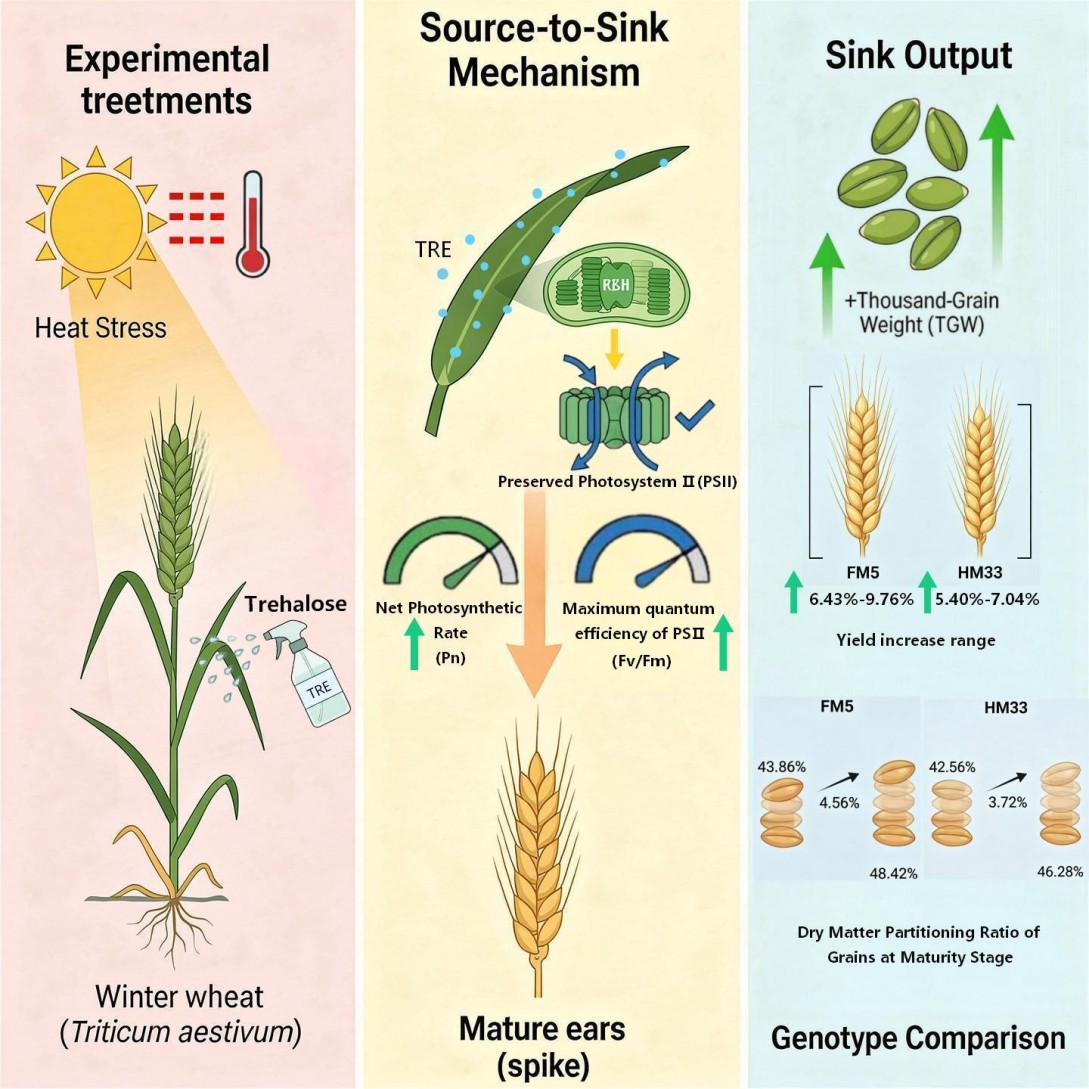
In the Huang-Huai-Hai region, high-temperature events frequently occur during the grain-filling stage, posing an increasing threat to winter wheat yield. Heat stress accelerates flag-leaf senescence and impairs post-anthesis photosynthesis, thereby limiting assimilate supply for grain filling. A two-year field experiment was conducted using the heat-tolerant cultivar ‘Huaimai 33’ (HM33) and the heat-sensitive cultivar ‘Fanmai 5’ (FM5). Trehalose (TRE) at 10, 15, and 20 mmol L⁻¹ was foliar-applied at anthesis, and passive warming was imposed from 15 days after anthesis for 5 consecutive days during grain filling. Grain yield, dry matter accumulation and allocation, flag-leaf photosynthetic characteristics, chlorophyll fluorescence, and sugar-related traits were determined. Heat stress markedly reduced grain yield and flag-leaf photosynthetic performance in both cultivars, with FM5 showing greater sensitivity than HM33. Among the TRE treatments, 15 mmol L⁻¹ TRE showed the greatest effect. Compared with the heat-stress treatment, 15 mmol L⁻¹ TRE increased grain yield by 5.40%–7.04% in HM33 and by 6.43%–9.76% in FM5 across the two growing seasons, mainly through increasing thousand-grain weight. At 21 days after anthesis, this treatment increased the net photosynthetic rate of flag leaves by 12.97% in HM33 and 19.08% in FM5. It also increased the proportion of dry matter allocated to grains at maturity from 42.56% to 46.28% in HM33 and from 43.86% to 48.42% in FM5. These results indicate that foliar application of 15 mmol L⁻¹ TRE alleviates terminal heat-induced yield loss by maintaining post-anthesis flag-leaf photosynthetic capacity and promoting assimilate allocation to grains. TRE application may provide a practical approach for improving wheat heat resilience during grain filling.