Dimerization of CRL1 and LBD16 is Essential for Crown Root Development in Rice
DOI:
https://doi.org/10.70737/fh5mxj88Keywords:
crown root; CRL1; LBD16; dimerizationAbstract
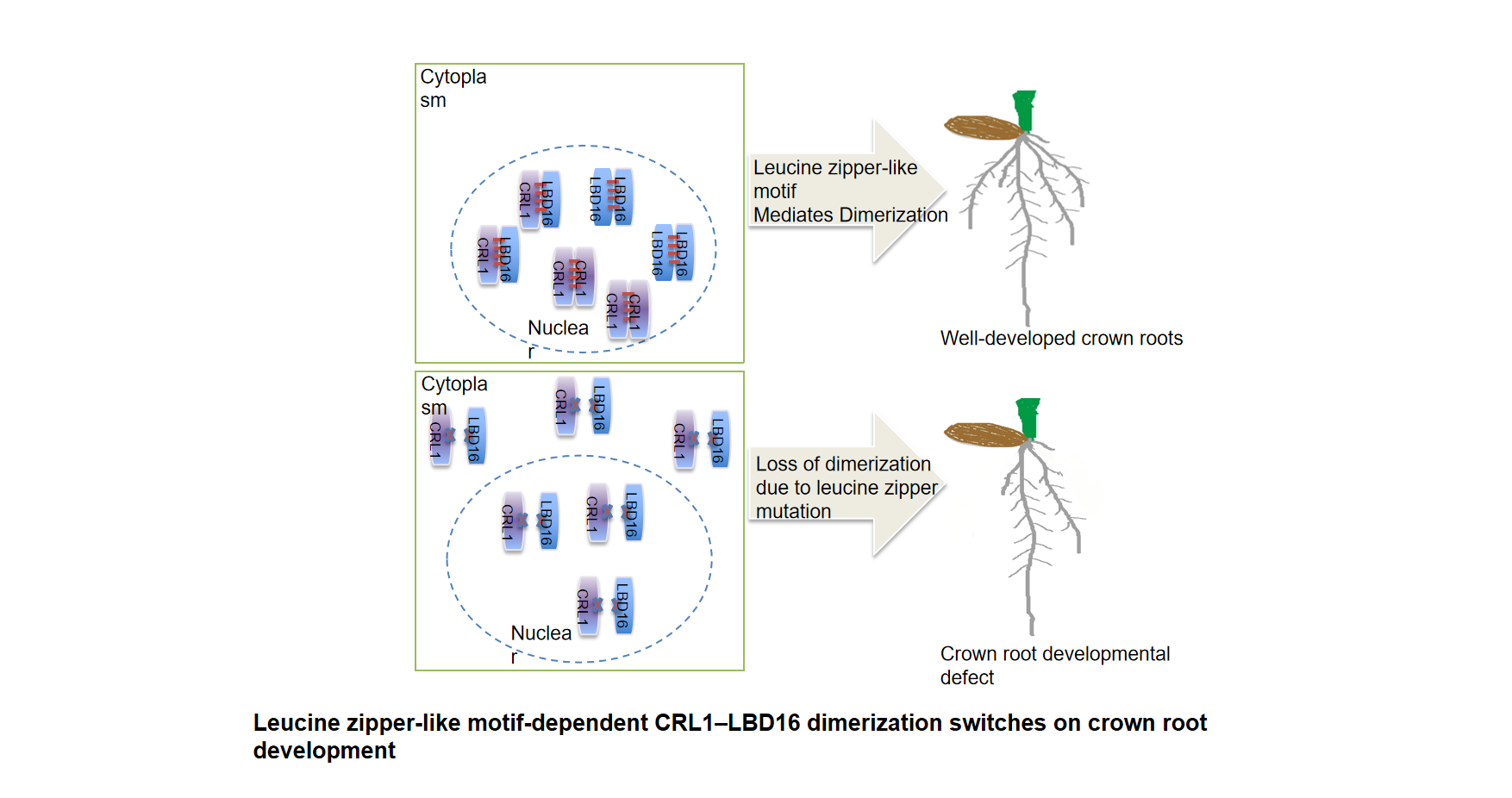
The Lateral Organ Boundary Domain (LBD) family proteins, characterized by a highly conserved Lateral Organ Boundaries (LOB) domain at the N-terminus, are plant-specific transcription factors that play essential roles in a wide range of organogenesis processes. Among them, two class I family members, Crown Rootless 1 (CRL1) and Lateral Organ Boundaries Domain 16 (LBD16), have been extensively studied for their crucial functions in crown root development in rice. Although the leucine zipper-like motif in the LOB domain is hypothesized to mediate protein dimerization, the specific mechanisms underlying homo- and heterodimer formation by CRL1 and LBD16, as well as the functional significance of such interactions in regulating crown root morphogenesis, remain largely unknown. In this study, we investigated the structural basis of leucine zipper-like motif-mediated dimerization of CRL1 and LBD16, and its functional consequences. Through pull down, Split-luciferase (LUC) and Co-immunoprecipitation (Co-IP) assays, we demonstrated that rice CRL1 and LBD16 can form homodimers (CRL1-CRL1, LBD16-LBD16) and heterodimers (CRL1-LBD16). Specifically, the conserved leucine residues within their leucine zipper-like motifs are essential for mediating this dimerization. Importantly, our results revealed that CRL1-LBD16 dimerization not only facilitates nuclear localization, but also acts as a molecular switch regulating their functional competence in crown root development. These findings have significantly advanced our understanding of the genetic and molecular mechanisms governing crown root morphogenesis in rice. They may also contribute to the formulation of strategies for the development of rice varieties featuring improved root architecture, enhanced yield potential, and optimized stress resilience.
References