Postponed Nitrogen Enhanced Waterlogged Summer Maize Soil Nutrients by Regulating Microbial Diversity and Network Complexity
DOI:
https://doi.org/10.70737/h5yxzy77Keywords:
waterlogging stress; postponed nitrogen application; summer maize; soil microbial diversity; network complexityAbstract
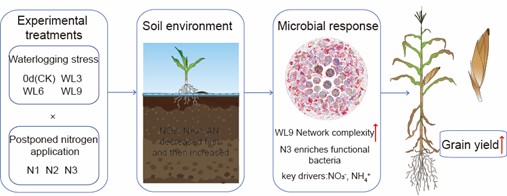
Waterlogging stress and low nitrogen use efficiency are important factors constraining summer maize production in the Huang-Huai-Hai region. However, how postponed nitrogen application modulates soil micro-ecological properties and mitigates yield loss in waterlogged summer maize fields by regulating soil microbial community diversity, co-occurrence networks, and community assembly processes remained rarely explored. In this study, summer maize at the three-leaf-one-heart stage was subjected to waterlogging for 3 (WL3), 6 (WL6), and 9 (WL9) days, and the treatment without artificial flooding was set as the control (CK). combined with three postponed nitrogen application ratios: N1 (70% basal fertilizer + 30% topdressing after stress relief), N2 (50% basal fertilizer + 30% topdressing after stress relief + 20% topdressing at the V12 stage), and N3 (30% basal fertilizer + 30% topdressing after stress relief + 40% topdressing at the V12 stage). Soil nutrients, microbial community diversity, network stability, and assembly processes were systematically analyzed. Results showed that N3 treatment increased the contents of soil total nitrogen, inorganic nitrogen, available phosphorus, alkali-hydrolyzable nitrogen and available potassium after waterlogging stress; prolonging the waterlogging duration increased the alpha diversity of soil bacteria at the flowering stage of summer maize. Under WL9 treatment, compared with N1 treatment, N2 treatment significantly increased the alpha diversity of farmland soil at the maturity stage. Linear discriminant analysis Effect Size (LEfSe) analysis revealed that under WL9 treatment, N3 treatment enriched putative nitrogen-cycling functional bacterial taxa such as Nitrolancea and Defluviicoccus, as well as saprophytic fungi including Blastocladiales, Acrophialophora, and Epicoccum. Nitrate nitrogen and ammonium nitrogen were identified as key environmental factors driving bacterial and fungal community diversity and structure at the maturity stage. Under the WL9 treatment, compared with N1, the N2 and N3 treatments increased network complexity by 30.61% and 46.94%, respectively. The migration rate and migration-drift parameter of bacterial and fungal communities increased with the increase of postponed nitrogen application ratio under CK and WL3 treatments. Under waterlogging conditions, compared with N1 treatment, N3 treatment increased summer maize yield by 27.29%–33.75%. Overall, the postponed nitrogen application improved micro-ecology of summer maize under waterlogging conditions by enhancing soil nutrient status, enriching microorganisms, and increasing network stability. This provides a theoretical basis for waterlogging prevention and optimized nitrogen management in summer maize production in the Huang-Huai-Hai region.
References