The Effect of Mineral-Based Soil Conditioners on the Improvement of Acidified Soils and Microbial Communities
DOI:
https://doi.org/10.70737/a559yd35Keywords:
soil conditioners; soil microorganisms; high-throughput sequencing; microbial symbiotic networkAbstract
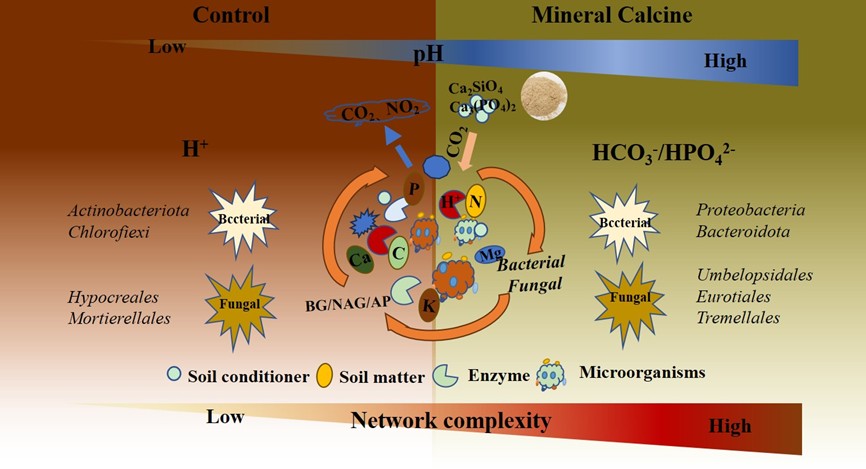
Soil acidification impairs nutrient availability, microbial structure and biogeochemical cycling, particularly in intensively cultivated tropical soils. Mineral-based soil conditioners have emerged as a potential solution, yet their effects on soil microbial networks and greenhouse gas emissions remain underexplored. Here, we evaluated four mineral-derived conditioners—a mineral blend (MB), calcined (MC), water-quenched (WQ), and commercial product (SC)—applied to acidic banana soil (pH 4.76) in a 100-day laboratory incubation. We assessed soil pH, exchangeable acidity, CO₂ and N₂O emissions, extracellular enzyme activities, and microbial community structure using 16S/ITS sequencing and co-occurrence network analysis. All conditioners significantly increased soil pH (to 6.06–7.25) and reduced exchangeable H⁺ and Al³⁺ (>85%). MB- and SC-treated soils markedly enhanced CO₂ emissions, while MC- and WQ-treated soils reduced N₂O emissions by 27.00% and 20.44%, respectively. Enzyme activities (β-glucosidase, N-acetylglucosaminidase) and microbial biomass carbon increased at early stages, especially in MB- and WQ-treated soils. Microbial diversity and network complexity were significantly enhanced by MC- and WQ-treated soils. Bacterial communities in these treatments exhibited higher modularity and positive associations, suggesting increased microbial connectivity and ecological resilience. Fungal networks responded more variably across treatments. Our results highlight the potential of mineral-based conditioners to alleviate soil acidity, regulate microbial-driven nutrient cycling, and mitigate N₂O emissions. These findings provide mechanistic insights into microbial responses under acid stress and offer sustainable options for managing degraded soils.